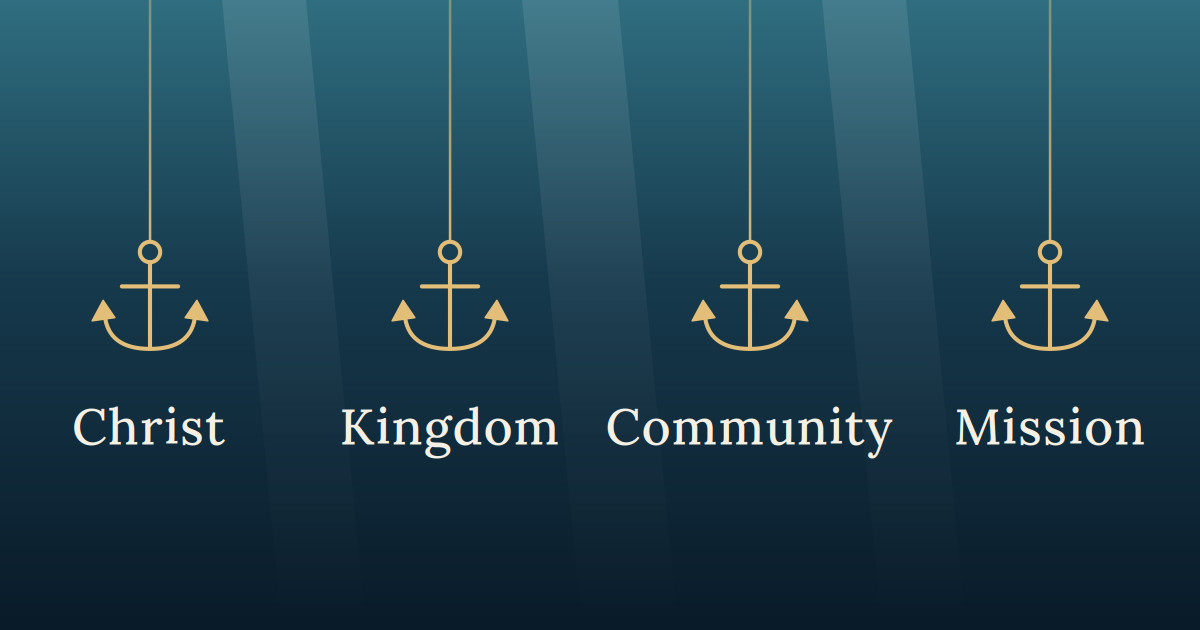
The church exists for something far greater than Sunday gatherings. It exists to root people in Christ, His Kingdom, His community, and His mission. These four commitments shape our preaching, our programs, our budget, and our calendar. When we’re healthy, everything we do flows from them. When we drift, this is where we come back to.
Christ
Everything we believe begins with a person, not a program or a philosophy. Jesus of Nazareth is the eternal Son of God. Paul writes that “all things were created through him and for him,” and that “in him all things hold together” (Colossians 1:16–17, ESV). He is not merely a moral teacher or an example to follow. He is Lord, and He is Savior.
As Savior, He redeems. He lived the life we haven’t lived and died the death we deserved, so that sin, guilt, and shame don’t have the final word over anyone. As Lord, He restores. He doesn’t just forgive us and leave us as we were. He renews us from the inside out and begins repairing what sin has broken in our hearts, our relationships, and the world.
Being rooted in Christ means He is the center of the church’s life, not one of several priorities. It shows up in how we:
- Preach the Scriptures, which testify to Him from beginning to end
- Worship, remembering who He is and what He has done
- Gather at the Lord’s Table
- Pray with confidence that He hears us
We want people to meet Jesus and be changed by Him, not just learn about Him. “As you received Christ Jesus the Lord, so walk in him, rooted and built up in him” (Colossians 2:6–7, ESV).
Kingdom
The first thing Jesus preached was not a set of rules or a plan for going to heaven. He announced that “the kingdom of God is at hand” (Mark 1:15, ESV). A kingdom means a king, and the Kingdom is simply God’s reign: His good and rightful rule over all things.
That reign broke into history through Jesus. We see it whenever the sick are healed, the captive are freed, sins are forgiven, enemies are reconciled, and the poor receive good news. We also live in the tension of “already” and “not yet.” The King has come and His rule is real, yet the world still groans under sin, injustice, and death. So we pray as He taught us: “Your kingdom come, your will be done, on earth as it is in heaven” (Matthew 6:10, ESV). The story isn’t finished.
To live for the Kingdom is to give Jesus allegiance in every area of life, not just the religious ones: work, money, marriage, parenting, citizenship, how we treat the person in front of us. It means:
- Seeking first “the kingdom of God and his righteousness” (Matthew 6:33, ESV), and trusting Him with the rest
- Holding truth and grace together, since Jesus came “full of grace and truth” (John 1:14, ESV) and we don’t get to choose one
- Practicing mercy, justice, and reconciliation as signs of the world to come
- Refusing to tie the Kingdom to any nation, party, or movement. Christ’s rule is greater than all of them and answers to none of them
We don’t build the Kingdom by our own strength. We bear witness to it and participate in what God is already doing, confident that He will finish it.
Community
You cannot follow Jesus well alone. From the beginning, God’s way of forming people has been to gather them into a family. The first Christians “devoted themselves to the apostles’ teaching and the fellowship” (Acts 2:42, ESV). They shared meals, met needs, and were known for how they loved one another: “By this all people will know that you are my disciples” (John 13:35, ESV).
Community is not an optional add-on to the Christian life, and it is not the same as attending the same event. It means being known, and knowing others, in a way that changes people. Scripture describes a body in which each part does its work and “makes the body grow so that it builds itself up in love” (Ephesians 4:16, ESV). That kind of growth happens in ordinary, unglamorous ways:
- Encouraging one another, especially when faith is hard
- Confessing sin and receiving grace instead of hiding
- Speaking truth in love, including when it’s uncomfortable
- Carrying burdens: meals, rides, prayer, time, and money
- Learning to forgive and be forgiven in real relationships
We call it His community because the church is not ours to design around our preferences. Christ gathers His people, and we are invited into what He is building. That means we resist the consumer mindset that treats church as a service to evaluate. Instead we ask what we can give, and we trust that we receive more than we bring.
[Insert here: how people can plug in, such as small groups, discipleship courses, serving teams, next steps.]
Mission
Jesus told His followers, “As the Father has sent me, even so I am sending you” (John 20:21, ESV). The church is not a destination. It is a sent people. He commissioned His followers to “make disciples of all nations” (Matthew 28:19, ESV) and promised, “I am with you always, to the end of the age” (Matthew 28:20, ESV).
Our mission is to carry the gospel, the good news of who Jesus is and what He has done, to people who have not yet come to know His love. That work has three inseparable parts.
We proclaim the message. The gospel is news, and news has to be told in words that people can hear and understand.
We embody the message. Our lives, service, and compassion make the words believable, and love that people can see gives them a reason to listen.
We demonstrate the message through the presence and power of the Holy Spirit. Paul reminded the Thessalonians that the gospel came to them “not only in word, but also in power and in the Holy Spirit” (1 Thessalonians 1:5, ESV). He described his own preaching as coming “in demonstration of the Spirit and of power” (1 Corinthians 2:4, ESV). We can’t manufacture this, and we don’t try. We depend on the Spirit to make Jesus known: convicting hearts, changing lives, healing and restoring as He chooses, and confirming that the message is true. Jesus promised His followers, “You will receive power when the Holy Spirit has come upon you” (Acts 1:8, ESV).
Any one of these alone falls short. Words without a life to back them up ring hollow. A good life without words leaves people guessing. Both without the Spirit are only human effort.
Mission is not the job of pastors and professionals. Every believer has a place in it, in the workplace, the neighborhood, the family, and the school, and through partnership with those sent across the world. It starts close to home and reaches “to the end of the earth” (Acts 1:8, ESV).
We don’t take up this mission out of guilt or anxiety. We are sent because we’ve been loved, and we have good news we can’t keep to ourselves. God has reconciled us to Himself, “entrusting to us the message of reconciliation” (2 Corinthians 5:19, ESV). The same grace that anchors us is what sends us, and the same Spirit who empowers us goes with us.
Anchored and Sent
These four are not separate programs. They are one life. We are anchored in Christ, we live under His Kingdom, we grow in His community, and we join His mission. That is what it means to be the Church: a people anchored in Jesus and sent out for His glory.
Scripture quotations are from the ESV® Bible (The Holy Bible, English Standard Version®), © 2001 by Crossway, a publishing ministry of Good News Publishers. Used by permission. All rights reserved.